
by Katalong Dasat, Content Team Academic
Hosting sounds cute until you are actually doing it. One minute you are imagining a wholesome evening with snacks, music, games and laughter. The next minute you are wiping down surfaces like you are preparing for an inspection, wondering why your heart is beating like it’s trying to escape your chest, and questioning every life choice that led you to this moment.
If you have ever felt this way, you are not alone. Hosting can stir up a lot of feelings like excitement, pressure, anticipation – and yes – anxiety, especially for young people who are still figuring out friendships and boundaries.
This guide is here to help you breathe, laugh a little, and remember that you don’t need to be a perfect host. You just need to be you, and that’s more than enough.
Why Hosting Feels So Big (Even When It’s Just Two Friends and a Pack of Crisps)
Let’s be honest, hosting can feel like a performance. Suddenly, your home becomes a stage, and you’re the lead actor, set designer, lighting technician, and catering team all at once. No wonder your brain goes into overdrive.

But here’s something comforting. Recent research shows that people with social anxiety often judge themselves far more harshly than others actually do, especially in situations where they feel ‘on display’ (Brassard & Kocovski, 2022). In reality, your guests are not judging, they are probably just happy to be invited.
There is no such thing as a “Perfect Host”
Somewhere along the line, we absorbed the idea that hosting means being flawless. The spotless home. The perfect snacks. The playlist that makes you seem effortlessly cool but not trying too hard.
Remember that perfection is exhausting and unnecessary.
A 2022 study found that self‑compassion helps people regulate their emotions and feel less overwhelmed in social situations, which is exactly what hosting can stir up (McBride et al., 2022). Being kind to yourself, especially when you are hosting, is not just nice – it’s powerful.
So instead of aiming for perfection, aim for “human being doing my best.” That’s the vibe.
Preparing to Host Without Losing Your Mind
Practical steps (the kind that do not require you to transform into an interior decor expert):
1. Keep It Small and Manageable
You don’t need to host a full house. A couple of friends is more than enough. Smaller gatherings feel safer, calmer, and easier to navigate.
2. Choose Low-Pressure Activities
Pick things that don’t require you to be “on” the whole time:
- A movie
- A board game
- A shared playlist
- A “bring your own snacks” hangout
- A craft night (chaotic but fun)
These activities shift the focus away from you and onto the shared experience.
3. Prep in Bite-Sized Pieces
You don’t need to clean your entire home like you’re preparing for an inspection. Break tasks into tiny steps:
- Tidy one corner
- Put snacks in bowls
- Light a candle
- Open a window for fresh air
Recent research with adolescents shows that self‑compassion and small, manageable steps can reduce the pressure people feel during stressful, evaluative moments (O’Driscoll & McAleese, 2023)
4. Set Up Your Space to Support You
Let your environment do some of the hosting:
- Soft lighting = instant calm
- Background music = no awkward silence
- A snack table = guests can help themselves
- A comfy corner = your personal recharge zone
- You are not being rude if you step away for a moment. You are being human.
The Moment Before Guests Arrive (AKA: The Peak Hour)

This is the part where your brain might start curating narratives.
“What if they think my place is weird?” “What if I run out of things to say?” “What if they are bored?” “What if I am boring?” “What if I forget how to be a person?”
Take a breath. This moment is temporary.
Here are some gentle grounding ideas you can use without anyone noticing:
• Hold something warm
A mug of tea, a hot chocolate, even a warm water bottle. Warmth signals safety to the body.
• Notice three colours in the room
A tiny grounding trick that brings you back to the present.
• Slow your pace
Walk slower. Talk slower. Move slower. It naturally calms your nervous system.
• Smile at someone you trust
Connection softens tension.
These aren’t medical techniques; they are just everyday ways to steady yourself.
When Guests Are Actually There
Once people arrive, your brain might still be buzzing. That’s okay. You don’t need to be the entertainer, the chef, the therapist, and the DJ all at once.
Here’s what helps:
1. Let Conversations Flow Naturally
You don’t need to plan every topic. Conversations have their own rhythm. If there’s a quiet moment, it’s not a failure it’s just a pause. You do not have to fix anything.
2. Share the Hosting
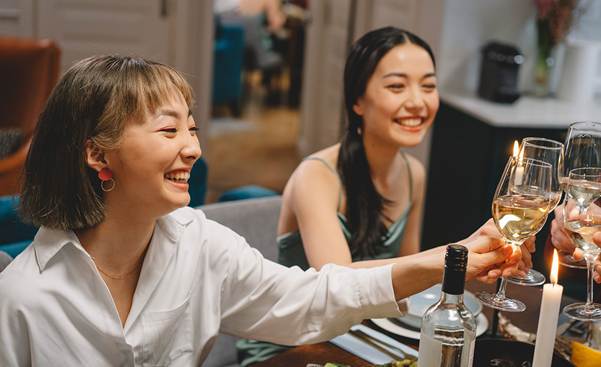
Let people help: “Can you grab the cups?”, “Would you mind choosing the next song?”, “Can you help me set up the game?”. People like feeling useful. It makes them feel at home.
3. Take Micro-Breaks
You can step away for a minute:
- To refill your drink
- To check the oven
- To breathe in the hallway
- Your guests will not think you are weird. They will think you are doing host duties.
4. Remember: People Came for You
Not your home. Not your snacks. Not your playlist. You.
They want to spend time with you the real you, not the polished, stressed, “I have to be perfect” version.
If Anxiety Shows Up Anyway (Because It’s Anxiety, and It Loves a Surprise Entrance)
Sometimes anxiety pops up even when you have done everything “right.” That doesn’t mean you have failed. It means you are human.
Here’s what you can do:
• Acknowledge it quietly
“Oh hey, anxiety. You are here. Not ideal, but okay.”
• Focus on one small thing
- Your drink.
- The texture of your outfit.
- The sound of someone laughing.
Stay connected to the moment
You do not need to push anxiety away.
You just need to stay present enough that it doesn’t take over the whole evening.
Manage it and repeat some of the grounding techniques that you find helpful.
• Use humour (internally or externally)
Humour is grounding. “My brain is doing parkour again. Classic.”
Humour doesn’t dismiss your feelings it softens them.
After Everyone Leaves: The Decompression Ritual
Once the door closes and the last guest is gone, your body might release all the tension it was holding.
You might feel:
- Relief
- Exhaustion
- Pride
- A sudden desire to lie on the floor
All of these are valid.
Here’s how to decompress gently:
• Change into comfy clothes
This promotes instant reset.
• Put on something familiar
A show you have watched 200 times. A playlist that feels like a hug.
• Drink something warm
Your nervous system loves warmth.
• Celebrate the win
Even if you felt anxious the whole time, you still hosted. That’s huge.
Hosting is a skill, not a personality trait. And you are building it, slowly and gently.
A Note for Young People Who Feel “Too Anxious to Host”
You are not too anxious. You are not behind. You are not failing at adulthood or friendship.
You are learning.
You are growing.
You are figuring out how to show up in the world while also caring for your mind and that is something to be proud of.
Hosting doesn’t have to be perfect like it is portrayed in the movies. It doesn’t have to be loud, or perfect, or Instagram-ready. It can be soft, simple, cosy, and entirely on your terms.
You get to define what hosting means for you.
How can No Panic help?
No Panic specialises in self-help recovery and our services include:
Providing people with the skills they need to manage their condition and work towards recovery.
Our aim is to give you all of the necessary advice, tools and support that you will need to recover and carry out this journey. https://nopanic.org.uk/support-services/
References
- Brassard, L.J., Kocovski, N.L. Impact of Social Anxiety and Type of Stressor on Levels of Self-compassion. Mindfulness 13, 1565–1576 (2022). https://doi.org/10.1007/s12671-022-01901-y
- McBride, N. L., Bates, G. W., Elphinstone, B., & Whitehead, R. (2022). Self‑compassion and social anxiety: The mediating effect of emotion regulation strategies and the influence of depressed mood. Psychology and Psychotherapy: Theory, Research and Practice, 95(4), 1036–1055. https://doi.org/10.1111/papt.12417
- O’Driscoll, D., & McAleese, M. (2023). The protective role of self-compassion on test anxiety among adolescents. Pastoral Care in Education, 41(2), 211–224. https://doi.org/10.1080/02643944.2022.2054021